Posted on 03:57 Hrs,February 3rd, 2010 by Stephen Sizer

With God on our Side:  Film Launch on Sunday 28th February, Christ Church, Virginia Water, GU25 4PT, 2:30pm

“With God On Our Side takes a look at the theology of Christian Zionism, which teaches that because the Jews are God’s chosen people, they have a divine right to the land of Israel. Aspects of this belief system lead some Christians in the West to give uncritical support to Israeli government policies, even those that privilege Jews at the expense of Palestinians, leading to great suffering among Muslim and Christian Palestinians alike and threatening Israel’s security as a whole.

This film demonstrates that there is a biblical alternative for Christians who want to love and support the people of Israel, a theology that doesn’t favor one people group over another but instead promotes peace and reconciliation for both Jews and Palestinians.”

Middle Eastern Perceptions of Western Christians

Issue of “Balance” When Sharing the Palestinian Narrative

Gary Burge on the Biblical View of Justice & the Middle East

The title for our film, “With God on Our Side” was inspired by the verse:

…while Joshua was there near Jericho: He looked up and saw right in front of him a man standing, holding his drawn sword. Joshua stepped up to him and said, “Whose side are you on—ours or our enemies’?” He said, “Neither. I’m commander of God’s army. Joshua 5:13-14a (The Message)

We believe this verse is still true today, that God does not take sides with certain people groups, nations or agendas. Rather He is for all people. Throughout history, those who have claimed God was on their side have used it to justify atrocities done in the name of Jesus. We believe once again certain Christians are approaching the people in the Middle East claiming God is on their side in a way that disregards human rights and gives unilateral support to a secular State, elevates one people group over another while using the Bible as justification. We believe there is a better way, a way of justice, peace and love for Jews and Palestinians. One that is inclusive, not exclusive. That is the heart of God.

See http://www.withgodonourside.com

Posted on 11:43 Hrs,October 27th, 2009 by Stephen Sizer

Amnesty International Report on Water in Palestine from Stephen Sizer on Vimeo.

Israeli settlers enjoy lush lawns and swimming pools while Palestinians reduced to a trickle of water

In a new report published today (27 October) Amnesty International has accused Israel of denying Palestinians the right to access adequate water by maintaining total control over shared water resources and pursuing discriminatory policies.

In this Premier Radio programme with John Pantry, Geoffrey Smith of Christian Friends of Israel and I debate the merits of the Amnesty International Report.

Amnesty’s 112-page report – Troubled Waters: Palestinians denied fair access to water – shows how Israel uses over 80% of the water from the Mountain Aquifer, the main source of underground water in Israel and the Occupied Palestinian Territories (OPT), while restricting Palestinian access to a mere 20%. The Mountain Aquifer is the only source of water for Palestinians in the West Bank, but only one of several for Israel, which also takes all the water available from the Jordan River.

On average, Palestinian daily water consumption barely reaches 70 litres per person a day, while Israeli daily consumption is more than 300 litres per day – four times as much. In some rural communities Palestinians survive on barely 20 litres per day, the minimum amount recommended by aid organisations for domestic use in emergency situations.

Some 180,000-200,000 Palestinians living in rural communities have no access to running water and the Israeli army often prevents them from even collecting rainwater. In contrast, Israeli settlers, who live in the West Bank in violation of international law, have intensive-irrigation farms, lush gardens and swimming pools. Numbering about 450,000, the settlers use as much or more water than the entire Palestinian population of some 2.3 million.

Amnesty International Israel and the OPT researcher Donatella Rovera said

“Israel allows the Palestinians access to only a fraction of the shared water resources, which lie mostly in the occupied West Bank, while the unlawful Israeli settlements there receive virtually unlimited supplies. In Gaza the Israeli blockade has made an already dire situation worse.

“Over more than 40 years of occupation, restrictions imposed by Israel on the Palestinians’ access to water have prevented the development of water infrastructure and facilities in the OPT, consequently denying hundreds of thousand of Palestinians the right to live a normal life, to have adequate food, housing, or health, and to economic development.

“Water is a basic need and a right, but for many Palestinians obtaining even poor-quality subsistence-level quantities of water has become a luxury that they can barely afford.

“Israel must end its discriminatory policies, immediately lift all the restrictions it imposes on Palestinians’ access to water, and take responsibility for addressing the problems it created by allowing Palestinians a fair share of the shared water resources.”

As Amnesty’s report makes clear, in the Gaza Strip 90-95% of the water from its only water resource – the Coastal Aquifer – is contaminated and unfit for human consumption. Yet, Israel does not allow the transfer of water from the Mountain Aquifer in the West Bank to Gaza.

Meanwhile, stringent restrictions imposed in recent years by Israel on the entry into Gaza of material and equipment necessary for the development and repair of infrastructure, have caused further deterioration of the water and sanitation situation in Gaza, which has now reached crisis point.

To cope with water shortages and lack of network supplies many Palestinians have to purchase water – of often dubious quality – from mobile water tankers at a much higher price. Others resort to water-saving measures which are detrimental to their and their families’ health and which hinder socio-economic development.

Troubled Waters explains that Israel has appropriated large areas of the water-rich Palestinian land it occupies and barred Palestinians from accessing them. In the West Bank and East Jerusalem it has also imposed a complex system of permits which the Palestinians must obtain from the Israeli army and other authorities in order to carry out water-related projects in the OPT. Applications for such permits are often rejected or subject to long delays.

Restrictions imposed by Israel on the movement of people and goods in the OPT further compound the difficulties Palestinians face when trying to carry out water and sanitation projects, or even when just distributing small quantities of water. Water tankers are forced to take long detours to avoid Israeli military checkpoints and roads which are out of bounds to Palestinians, resulting in steep increases in the price of water.

In rural areas, Palestinian villagers are continuously struggling to find enough water for their basic needs, as the Israeli army often destroys their rainwater harvesting cisterns and confiscates their water tankers. In comparison, in nearby Israeli settlements, irrigation sprinklers water the fields in the midday sun, where much water is wasted as it evaporates before even reaching the ground.

In some Palestinian villages, because their access to water has been so severely restricted, farmers are unable to cultivate the land, or even to grow small amounts of food for their personal consumption or for animal fodder, and have thus been forced to reduce the size of their herds.

Read more here

Download the Amnesty Report here

See also Donald McIntyre in the Independent

Listen here

Posted on 10:40 Hrs,September 17th, 2009 by Stephen Sizer

Last night I spoke at the Albury History Society. The subject was “Edward Irving, the Albury Circle and the Origins of the Middle East Conflict”. I explained how the Arab-Israeli conflict could be traced right back to the eccentric views of Edward Irving and his colleagues, who met in the home of Henry Drummond in Albury, Surrey, during Advent 1826. Irving was largely responsible for popularising the notion that God had a separate purpose for the Jewish people apart from the Church and restored to Palestine. John Darby took these ideas further and fashioned them into what became known as Dispensationalism which is now the domnant theological framework of Evangelicals, Fundamentalists and Pentecostals in the USA. It is this constiuency that is underwriting financial and political support for the agenda of the Zionist Lobby, and hence a major obstacle to peace in the Middle East.

The full text is available here. Listen to the presentation here

The feedback was encouraging. I received this letter from the chairman following the presentation:

“I have never experienced such a positive reaction to a guest speaker as came about last night, and has continued to this morning. The audience was both numerous and responsive, and as one member put it to me “it is going to be a hard act to follow”. I think that we shall be talking about Christian Zionism for some time, having long harboured suspicions of chicanery in high political circles, and now being presented with conclusive evidence of it. We could also have brought in the French pope who set off the chain of crusades for his own political preservation.

I express my gratitude to you on behalf of the Albury History Society and thank you for a superb presentation, technically faultless, and intellectually challenging. With kindest regards…”

| Posted in Bible, Christian Zionism, Israel, Middle East, Palestine, Theology | Comments Off
Posted on 05:47 Hrs,August 10th, 2009 by Stephen Sizer

I am delighted to endorse a new film being launched this autumn produced by Porter Speakman Jr and Rooftop Productions.

“With God On Our Side takes a look at the theology of Christian Zionism, which teaches that because the Jews are God’s chosen people, they have a divine right to the land of Israel. Aspects of this belief system lead some Christians in the West to give uncritical support to Israeli government policies, even those that privilege Jews at the expense of Palestinians, leading to great suffering among Muslim and Christian Palestinians alike and threatening Israel’s security as a whole.

This film demonstrates that there is a biblical alternative for Christians who want to love and support the people of Israel, a theology that doesn’t favor one people group over another but instead promotes peace and reconciliation for both Jews and Palestinians.”

Launch: Autumn 2009. More news soon.

With God on our Side – Website, FaceBook and YouTube

Posted on 15:19 Hrs,June 21st, 2009 by Stephen Sizer

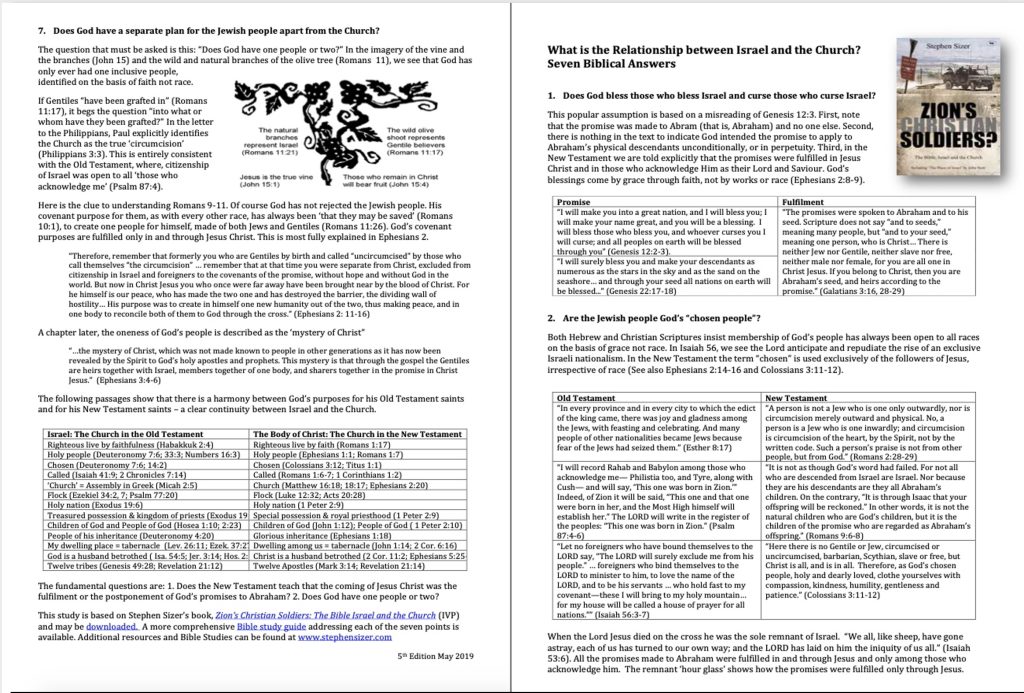
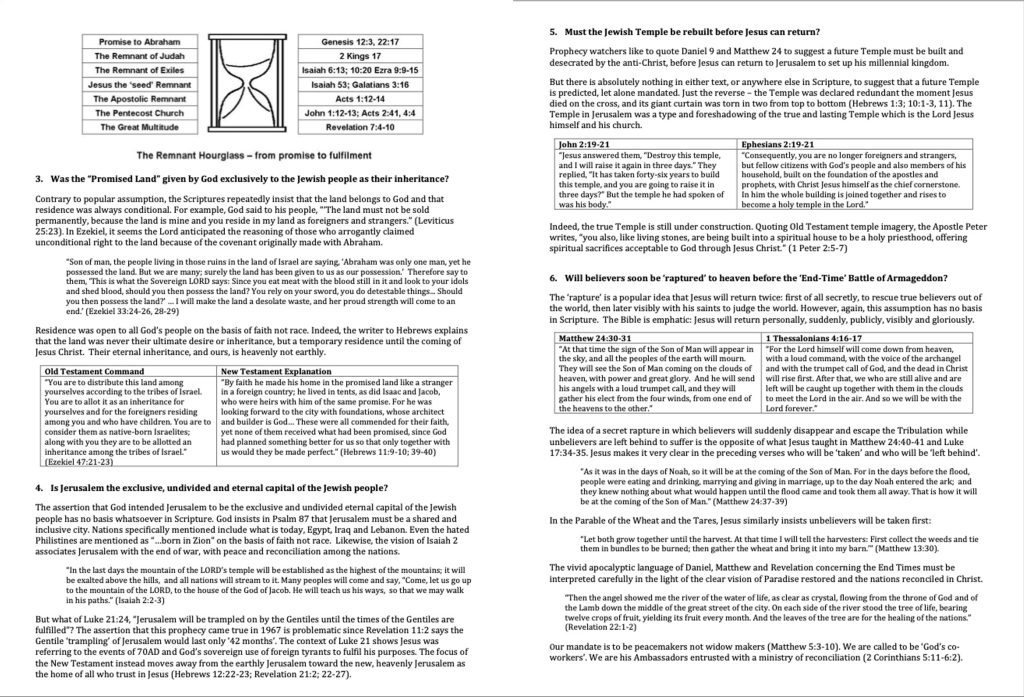
The latest edition of Churchman, published by the Church Society, includes a review of Zion’s Christian Soldiers written by Ed Moll,

“Does God have a purpose for the nation and land of Israel today? This is a major point of difference between Dispensational and Covenantal readings of the Bible. In Zion’s Christian Soldiers Sizer exposes the foundations of Dispensational views, and the error of their strong support for certain views about Israel today. Given the widespread influence of this school of thought, there is the frightening propsect that the US might adopt foreign policy under (Dispensational) Christian influence.

The key issue in understanding the relationship between Israel and the Church is to read the Bible literally and contextually. Ultra-literalists ignore the historical settingof prophetic and apocalyptic passages and then read contemporary events back into prophetic passages. As a consequence Old Testament texts are made to speak about present and future events almost as if the New Testament had never been written. But by reading the Bible as a whole and in context it becomes clear that there is not, in fact, two chosen people (Israel and the church) but one (Israel and now the church).

A second consequence is that those who believe the promises made to Abraham still apply to his phisical descendents today oppose the dismantling of Jewish settlements in Gaza and the Occupied Territory; but the Bible makes clear that the Land is God’s and that residence in it was always conditional on faithful obedience. Jesus redefined the kingdom as a spiritual and heavenly reality, which is why the New Testament teaches that the land has served its purpose: ‘it was and remains, irrelevant to God’s on going redemptive purposes for the world’ (p. 98). In a similar way, Christians are to look to Jerusalem as a vision of a city inclusive of all nations-not as a place which must remain undivided at all (political) costs.

Two of the stranger beliefs promoted by Dispensationalist thinking are the rebuilding of the Temple, and the Rapture. Attempts by Zionists (Jewish and Christian) to rebuild the Temple are taken seriously by the political authorities, and may well ignite an apocalyptic war with Muslims worldwide. But when Jesus died to atone for our sins, the temple in Jerusalem became redundant: that is why Sizer must say that ‘To advocate rebuilding the Temple is heresy’ (p. 130). The Rapture is ‘the novel idea that Jesus will return twice’ (p. 131), made popular by the hugely successful “Left Behind” books. It accompanies an outlook which is inherently pessimistic about the Middle East and looks for an “Armageddon” confrontation. But biblical references to Armageddon do not necessarily lock us into believing there has to be an apocalyptic war between Islam and Christianity; surely as peacemakers, Chrisitans can have nothing to do with stoking such a conflagration.

The key issue remains, ‘What difference did Jesus’ coming make to traditional Jewish hopes and expectations?’ Sizer shows by his clear and direct treatment how Dispensational writers (including Hagee, Scofield, Darby and Hal Lindsey) fail to address this question. This is a clear and helpful book, which requires no prior understanding of Dispensationalist thinking. It will equip the reader to understand these views and to appreciate what is at stake when thoswe who believe these things try to make governments and Christians follow them.”

Ed Moll
Vicar of St George’s, Wembdon, Somerset
and a Trustee of the Latimer Trust

| Posted in Christian Zionism | Comments Off
Posted on 13:31 Hrs,May 9th, 2009 by Stephen Sizer

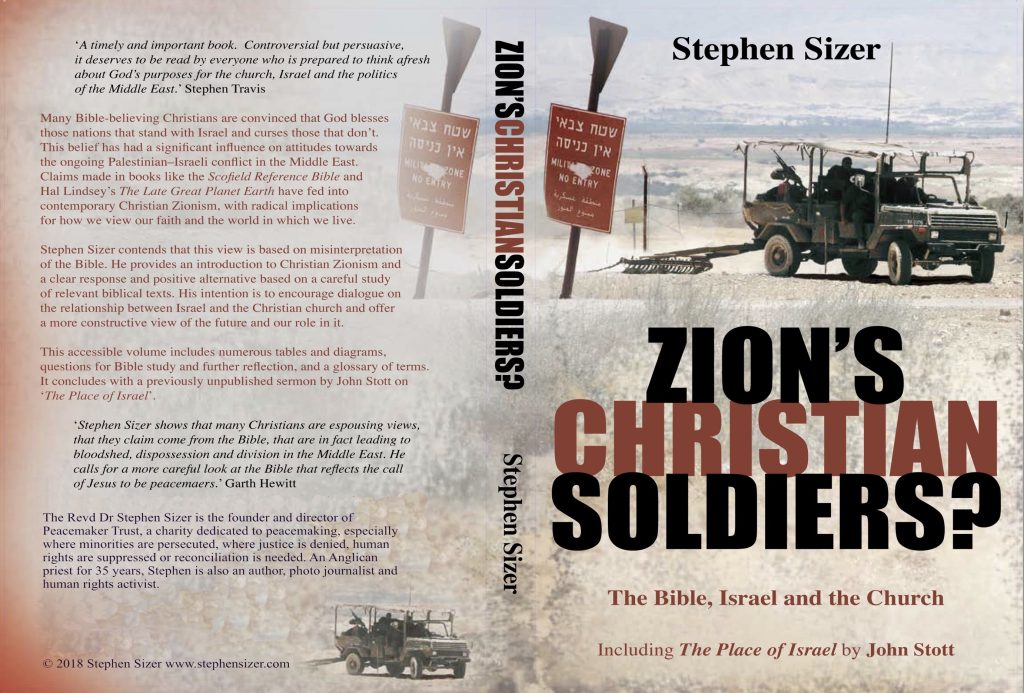
A Spanish edition of my book Christian Zionism: Roadmap to Armageddon? has been published by Bosforo Libros in Madrid, Spain.

Foreword to Spanish Translation

I am delighted that you are reading my book in Spanish – something regrettably I cannot do – at least not yet. I wrote this book for three reasons – truth, justice and reconciliation.

My first motivation is the need to speak the truth. Jesus said, “...you shall know the truth, and the truth will set you free.” (John 8:32). Sadly the Christian faith has, for many centuries, become equated with colonialism and empire in many parts of the world. In the Middle East, this is largely due to the influence of European Christians who, nearly 200 years ago, believed it was their destiny to assist the Jewish people in colonising Palestine. This movement which became known as Christian Zionism, gave rise not only to Zionism and the founding of the State of Israel, but also to the Palestinian Nakba and the Arab-Israeli conflict. Many Christian Zionists see the coming of Jesus as the postponement rather than the fulfilment of the promises God made to the Hebrew people. Their emphasis on Israel and end-times prophecy, rather than upon Jesus and the gospel, is a distortion of the Bible.

My second motivation is justice. Micah asks, “What does the Lord require of you? To act justly and to love mercy and to walk humbly with your God.” (Micah 6:8). It is too easy and convenient for Christians to blame others, especially the Arabs or Islam for the ills of the world. The Middle East conflict is being perpetuated largely by American Christians who have popularised the notion that God blesses nations that support Israel. We must be honest about our historical complicity in the conflict and commit ourselves to working for peace with justice for all, irrespective of their race or religion, and based on the rule of international law.

My third motivation is reconciliation. Jesus is described as “The Prince of Peace” (Isaiah 9:6). He has commanded his followers to pursue a ministry of reconciliation (2 Corinthians 5). We are called to be peace-makers not widow-makers. Christian Zionism in its most extreme form is pathologically confrontational and apocalyptic about the future. It is in danger of becoming a self-fulfilling prophecy. God’s word instead tells us to “Turn from evil and do good; seek peace and pursue it.” (1 Peter 3:11). At the end of the Book of Revelation there is a beautiful image of paradise restored in which the Tree of Life bears fruit every month. We are told “And the leaves of the tree are for the healing of the nations.”  (Revelation 22:2). If this is God’s view of the future, then we need no greater motivation to work for reconciliation now.

I believe that when we re-examine our history and repudiate the false ways in which some of our leaders have abused the Scriptures for destructive political ends, we will be better able to contribute to justice, peace and reconciliation in the Middle East. By the grace of God, I pray that this book will motivate you to contribute to that process.

If you find it helpful, you can access further resources, text, audio and video at www.stephensizer.com as well as read my latest blog and view my photographic gallery of the Middle East. The sequel to this book is entitled, Zion’s Christian Soldiers, and addresses in more detail, the relationship between Israel and the Church in Scripture. At the moment it is only available in English but I hope a Spanish edition will be published soon.

Sinopsis

Apenas conocido en Europa, el fenómeno del sionismoi cristiano en Estados Unidos vive en los últimos años un auge cuyas reales dimensiones podemos comprender con una sola cifra: los más de 65 millones de libros vendidos por los 16 volúmenes de la serie Left Behind, de Tim LaHaye y Jerry Jenkins, una ficcionalización de las doctrinas del sionismoi cristiano respecto a Israel y el fin de los tiempos.

Surgido como corriente milenarista en la Inglaterra decimonónica, implantado en los Estados Unidos por el pastor John Nelson Darby y crecido al calor del fundamentalismo evangélico norteamericano, el sionismoi cristiano considera que sólo cuando el pueblo elegido de Israel esté en posesión de todo el territorio comprendido entre el río Éufrates y el río Nilo (Eretz Israel, el Gran Israel, tal como lo recoge el Génesis) tendrán lugar los acontecimientos anunciados por las profecías bíblicas: el Armagedón (la batalla final) y la segunda venida de Cristo para instaurar el Reino de Dios.  A falta de datos precisos, los expertos consideran que hay decenas de millones de personas en Estados Unidos que comparten estas creencias.

El sionismoi cristiano ha jugado un papel histórico determinante en la creación y sustento del Estado de Israel. Este rol se ha reforzado en el curso de las últimas décadas, y en la actualidad continúa desempeñándose de las más diversas formas, desde la presión política en Washington y el adoctrinamiento masivo a través de los medios (véanse los casos de Pat Robertson y del finado Jerry Falwell, o la citada saga de los Left Behind) a la financiación directa de la emigración judía a Israel y de los asentamientos de las ocupadas Cisjordania y Jerusalén Este.

Sionismoi cristiano: ¿Hoja de Ruta a Armagedón?, fruto de la investigación doctoral del teólogo británico Stephen Sizer, se ha convertido en el texto de referencia para todo aquel interesado en conocer el origen y desarrollo histórico del sionismoi cristiano, las razones de su identificación total con el proyecto sionistai del Estado de Israel y su decisiva influencia en el devenir cotidiano del conflicto, tanto en las altas esferas de la administración estadounidense como en su contribución sobre el terreno a las políticas de limpieza étnica y expansionismo israelíes. En definitiva, para entender en gran medida por qué la paz y la justicia parecen aún inalcanzables en Oriente Próximo.

Leer un fragmento

Leer capítuloIntroducción

Índice

Prólogo
Prólogo a la edición en español
Prefacio
Agradecimientos
Listado de figuras

Introducción
¿Qué es el sionismoi?
¿Qué es el sionismoi cristiano?
La importancia del movimiento sionistai cristiano
Un análisis crítico del sionismoi cristiano

1. Las raíces históricas del sionismoi cristiano
Los primeros indicios: el sionismoi cristiano primigenio
El nacimiento del sionismoi cristiano y su contexto socio-político
Los orígenes del restauracionismo premilenarista histórico en Gran Bretaña
Los orígenes del sionismoi cristiano dispensacional en Gran Bretaña
Lord Shaftesbury y la influencia del restauracionismo en la política exterior de Gran Bretaña
El cristianismo británico y su apoyo político al movimiento sionistai judío
La Declaración Balfour y la implementación del sueño sionistai
El dispensacionalismo y el nacimiento del sionismoi cristiano en Estados Unidos (1859-1945)
El antisemitismoi y el sionismoi cristiano liberal en Estados Unidos (1918-1967)
El sionismoi cristiano evangélico en los Estados Unidos de hoy (1967-2002)
La proliferación y diversificación de las organizaciones sionistasi cristianas
Las raíces históricas del sionismoi cristiano: conclusiones

2. Los fundamentos teológicos del sionismoi cristiano
La Biblia: una hermenéutica literal y futurista
Los pueblos elegidos: la relación entre Israel y la iglesia
El restauracionismo: regreso de los judíos a Sion
La Tierra de Israel: reclamando Judea, Samaria y más allá
Jerusalén: la capital eterna y exclusiva del pueblo judío
El templo: reconstrucción y profanación
El futuro: la escatología del sionismoi cristiano
La singular teología del sionismoi cristiano: conclusiones

3. Las implicaciones políticas del sionismoi cristiano
El pueblo elegido: apoyar el colonialismo israelí
El restauracionismo: facilitar la emigración de los judíos de Rusia y Europa oriental
La Tierra de Israel: apoyar los asentamientos de Cisjordania
Jerusalén: los grupos de presión y el reconocimiento internacional
El templo: identificarse con el sionismoi religioso
El futuro: rechazar los procesos de paz y precipitar el Armagedón
Las implicaciones políticas del sionismoi cristiano: conclusiones

4. Conclusiones
Observaciones acerca de la evolución del sionismoi cristiano
Variantes del sionismoi cristiano
Aspectos constructivos y destructivos del sionismoi cristiano
Evaluación crítica del sionismoi cristiano
El sionismoi bíblico y su alternativa en la teología de la Alianza

Glosario
Apéndice
Bibliografía
Índice de personas
Índice de temas
Índice de referencias bíblicas

El autor

Stephen Sizer (1953, Lowestoft) es doctor en Teología, miembro y antiguo director de la International Bible Society y miembro fundador del Instituto para el Estudio del Sionismoi Cristiano (www.christianzionism.org). En la actualidad ejerce como vicario en la parroquia de Christ Church, Virginia Water (Surrey, Inglaterra).

Asiduo visitante de Oriente Próximo y máxima autoridad internacional en cuestiones vinculadas al sionismoi cristiano y sus implicaciones teológicas y políticas en el conflicto palestino-israelí, Stephen Sizer ha expuesto sus argumentos en buen número de artículos y conferencias –en Oxford, Cambridge, Glasgow, Chicago, Yakarta, El Cairo o Teherán–, cuya culminación es el presente volumen, que sintetiza para el gran público siete largos años de trabajo doctoral en instituciones académicas.

Stephen Sizer es además autor de otros libros: A Panorama of the Holy Land (Eagle, 1998), A Panorama of the Bible Lands (Eagle, 2002), In the Footsteps of Jesus and the Apostles (Eagle, 2004) y Zion’s Christian Soldiers: The Bible, Israel and the Church (IVP, 2007).

Reseñas

Reseñas sobre "Sionismo cristiano" de Stephen Sizer Reseñas sobre el libro (en inglés)

| Posted in Christian Zionism | Comments Off
Posted on 04:19 Hrs,May 8th, 2009 by Stephen Sizer

The Gary DeMar Show on American Vision is your 15 minutes of sanity each weekday. Four out of five doctors surveyed recommend this show along with a large dose of commonsense to help combat the insanity served up by the mainstream media.

Gary DeMar serves your daily recommended allowance of rationality. Gary’s Show is where you will hear current events, pop culture, politics, religion, and bunches of other stuff examined through the lense of a biblical worldview.

Gary DeMar and Stephen Sizer discuss Christian Zionism and its impact on the Middle East in a series of 15 minute audio/video interviews recorded in April 2009.

Christian Zionism and the Middle East Conflict

An Overview of the History of Christian Zionism

Christian Zionism and the Middle East

The Rise of Christian Zionism

Culture Wars of Middle Eastern Civilizations

American Vision’s (AV’s) mission has been to Restore America to its Biblical Foundation—from Genesis to Revelation since 1978. AV realizes that this task requires a strategy to “Make disciples (not just converts) of all nations and teach them to obey and apply the Bible to all of life” (Matt. 28:18-20). So AV developed a method to accomplish this in our lives by way of illustration to understand all that encompasses God’s plan for spiritual growth. In doing so, it also became the way in which we now recognize the ministry with our new trademark (see the top left of the website).

To follow our train of thought, the structure (on the left) is a bottom up approach to developing a fruitful Christian life. By way of a Biblical Education—knowing what the Bible has to say—we study the four  essential parts of knowledge: history, apologetics, ethics, and eschatology. Once we gather a solid understanding of the Bible and gain knowledge in these four essential areas of life, Christian worldview and character sinks in to personally develop maturity and wisdom. By way of Christian maturity, we can exercise “Servanthood Dominion” over all God’s world as He has commanded us to do. This is what American Vision is all about.

| Posted in Christian Zionism | Comments Off
Posted on 04:59 Hrs,May 1st, 2009 by Stephen Sizer

Stephen Sizer expands on the roots of Christian Zionism and its political implications during his lecture on Wednesday in Demaray Hall.

By BETH DOUGLASS, News Writer

Published: April 29 2009

The United States’ support of Israel is built on faulty principles and is hurting the country’s foreign policy, evangelical Anglican pastor and London author Stephen Sizer said.

Yesterday afternoon, Sizer spoke in Demaray Hall 150 at an event called “Christian Zionism: What is it? Its history, theology and political impact on the world today.”

Throughout the Israel-Palestinian conflict, the United States has offered unwavering support to Israel, Sizer said. Much of this is due to the prevalence of Christian Zionism, or Christians who support the modern political state of Israel, established in 1948, he said.

There is an antipathy toward the Arabs and Palestinians within Christian Zionism, Sizer said. He countered that the Bible calls us to reconciliation and tells us to love our enemies, he said.

“This theology is impacting attitudes and opinions in the Middle East,” he said. There is a view that God is blessing America because the nation is helping Israel, he said, resulting in the demonizing of Islam and the characterization of Arabs as dogs and liars.

Giving Israel a geographic homeland in Palestine may not be the correct fulfillment of God’s Old Testament promise to Israel, he said.

Palestine was turned into a secular state for Israel after World War II, according to the Rooftop Productions film “With God on Our Side.” From then on, Israel continued to take over Palestinian land, leaving many refugees.

Israelis then engaged in what some call an “ethnic cleansing” of Palestinians, the film stated.

Growing up in the church and hearing many Old Testament Bible stories, U.S. Christians tend to idealize and romanticize Israel and Israeli culture, the film said.

When Americans hear about a conflict involving Israel, it seems obvious whose side they are on, the film said.

SPU is a very social justice-minded campus, yet there is little conversation about the situation in Palestine, said junior Kristin McCarthy, who helped plan the event.

“I think it is so sad how few people actually know about what is happening in Israel and Palestine,” she said.

Twenty to 40 million Americans support the Christian Zionism movement, according to the Pew Forum on Religion.

“I argue that it is shaping your foreign policy in the Middle East,” Sizer said.

Pro-Israeli groups are probably the most powerful lobbyists on Capitol Hill, Sizer said. Many of these lobbyists are Christian organizations.

Two-thirds of U.S. foreign aid goes to either Egypt or Israel, said John Berg, director of ministry advancement and development for a nonprofit organization called the Middle East Fellowship. The U.S. gives $10 billion per year to Israel, consisting of both official and unofficial foreign aid, he said.

“So much of our taxpayer money does go to the state of Israel,” said Professor of English Doug Thorpe. This makes U.S. Christians deeply invested in the Israel-Palestinian conflict, he said, and people are suffering because of how American foreign policy supports Israel.

No U.S. senator will speak against Israel, Sizer said, because to criticize Israel would be political suicide.

Some people have said Sizer’s viewpoint is anti-Semitic. However, he firmly upholds that this is not the case.

“I repudiate anti-Semitism unequivocally. Anti-Semitism is a form of racism,” Sizer said.

Fear of being anti-Semitic should not keep us from thinking critically about Christian Zionist ideas, Berg said.

There is a difference between Jewish ethnicity, Jewish religion and the modern country of Israel, Berg said. Historic anti-Semitism was against the Jewish ethnicity, he said, and Christian Zionism has redefined anti-Semitism.

The purpose of having Sizer speak on campus was not to advocate one particular viewpoint, but to start a conversation about the issue, McCarthy said.

“I think this is a really important conversation for the Christian community to be having,” she said.

Source: The Falcon Online

| Posted in Christian Zionism, Middle East | Comments Off
Posted on 06:59 Hrs,April 27th, 2009 by Stephen Sizer

World Vision’s executive director for international relations until March 1, 2009, Thomas Getman managed World Vision’s liaison activities with the UN and the World Council of Churches and was responsible for diplomatic relations with UN government member missions in Geneva and with countries on sensitive negotiations.

He served until recently on the board of principals for the UN Deputy Secretary General for Emergency Relief and as chair of the premier NGO consortium International Council of Voluntary Agencies.

From 1997 to 2001, Getman served as director of World Vision’s programs in Jerusalem, the West Bank and the Gaza Strip where he was responsible for $5-8 million a year in relief and development projects in Palestine and Israel and advocacy for peace with justice.

Previously, Getman served for 12 years as director of government relations and special assistant to the president of World Vision United States at which time he founded WV’s office in DC. Getman interpreted U.S. government policy, pressed for needed foreign assistance, and advanced human rights, relief and development concerns.

From 1976 to 1985, as a Congressional staff member, Getman helped negotiate protocols with the presidents of Uganda and Zambia and encouraged warring factions to move forward with peace negotiations. In the mid-1980s, Getman played a central role to persuade the South African Foreign Ministry to cease support for the Mozambican rebel group Resistencia National Mocambicana (Renamo). He also was an adjunct speech writer for other national political figures, including President Gerald R. Ford.

Before joining World Vision, Getman served as legislative director and senior speech collaborator to U.S. Senator Mark Hatfield. In the US Senate, his primary assignments were African foreign policy and social justice, human rights and welfare issues. His most notable legislative contribution was to participate in the drafting team for the Anti-Apartheid Act of 1985. Getman also served as a regional director for Young Life for nine years in New England.

I caught up with Tom at St Mark’s Church on Capitol Hill in Washington and asked him about the role of Christian Zionism, his hopes for the new US administration and the changes needed in US policy in the Middle East.

I also inteviewed Joan Drake of Partners for Peace, Jim Vitarello of Sharing Jerualem

Posted on 15:22 Hrs,April 21st, 2009 by Stephen Sizer

Last night I gave a lecture to faculty and students at Palm Beach Atlantic University in Florida.

The lecture addressed Christian Zionism and the relationship between Israel and the Church in Scripture. Students had been asked to read my book Zion’s Christian Soldiers in preparation and were energised and articulate in the Q&A that followed.

You can listen to, or read, three presentations that amplify the lecture, as well as view PowerPoint presentations that you may find useful for personal and group Bible study.

The History of Christian Zionism + PowerPoint
The Theology of Christian Zionism + PowerPoint
The Politics of Christian Zionism + PowerPoint

Christian Zionism: Roadmap to Armageddon?

Christian Zionism: An Introduction
1. Historical Roots
2. Theological Basis
3. Political Consequences
Conclusions

Palm Beach Atlantic is one of my favourite places in the USA. The setting is idylic with beautiful beaches and tall palm trees nearby. The weather is sunny and warm at this time of year although we had a torrential thunder storm in the night.

The university is unique in Florida – an evangelical Christian institution with a core emphasis in the liberal arts. I interviewed one of the faculty – Gerald Wright – about his work at Palm Beach Atlantic: